By Ben King
A blog exploring how Black culture and identity changed Britains pop culture and music throughout the 20th century.
Blog 1: 1900 to the 1950s
In the 20th century, Britain was introduced to a style of music developed in the deep south of America from blues and ragtime. This music was Jazz. Jazz quickly took to the underground scene in Britain with bands arriving in Britain such as the Original Dixieland Jazz band in 1917.[1] The movement had to remain underground due to the remaining colonial-era supremacy of the British people at the time, this supremacy would often result in racially-based attacks.[2]
In 1948, the SS Empire Windrush arrived at the Tilbury harbour, bringing around 500 commonwealth migrants on the request of the government to rebuild the country after the second world war. These people were from the Caribbean islands, among them was Aldwin Roberts, who went by the stage name of Lord Kitchener, with him he brought the Trinidadian style of folk music, Calypso.
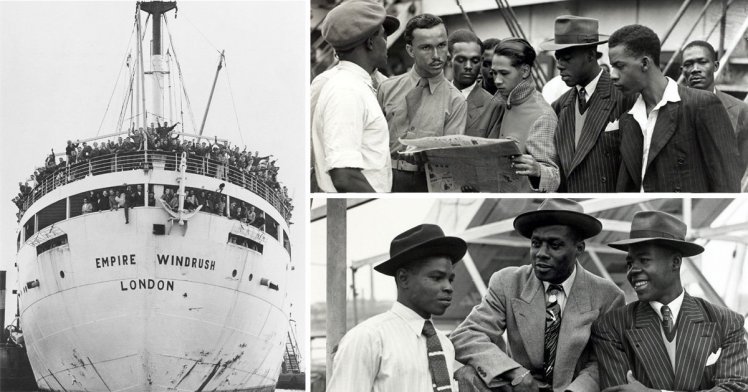
With the government call for people to work, came the expectation of a better life, as being part of the commonwealth, the people had been taught to think of Britain as the ‘mother country’.[3] The reality, however, was very different. Migrants were made to struggle as there was discrimination in employment, housing and on the streets, with signs such as ‘Room to let – No coloured men’ being a common sight. As the migrant population grew as did the ‘ideology of whiteness’ coming from Independence of countries that were previously owned by the British Empire alongside colonial-era science and sexual jealousy, such discrimination led to the groups of Black people to form their communities with the commonality of the shared discrimination from the time.[4] The couple of decades after Windrush was to be some of the worst times experienced for Caribbean migrants in Britain.[5] This is reflected in the 1958 race riots across London in August through to September, as the non-white community was forced to live in squalid conditions with landlords who threatening physical harm to their tenants. However, media sensationalised these riots and so migrant communities found themselves terrorised both through violence from groups such as the ‘teddy boys’ who were known for going out on the streets on weekends with the intent of open hostility against any non-white immigrant that could be found.[6] These attacks became more frequent as the anti-black riots in London started to take place, by the end of August it was a nightly affair to have crowds parading known areas of residency for immigrants, wreaking havoc to people’s property and causing harm to the people themselves. One man was recorded to have said, ‘Black people are treated worse than a dog here. They watch you wherever you go. You daren’t go out in the evening – it’s a prison, this country.’ With the police taking little notice of these attacks the community grew closer, music was a key component to this community in way of expressing their racial inequity.

However, with examples of American civils rights, non-white immigrants found strength in their communities and music. Music was a primary way for people to show pride in their race despite everything happening in the outside world.[6] It would seem that the politics of the day was to set the tone for the music of the following decades, this will be explored in my following posts.
[1] Jason Toynbee, “Race, History and Black British Jazz,” Black Music Research Journal Vol 33 No 1 (Spring 2013): 2.
[2] Toynbee, “Race, History and Black British Jazz,” 2.
[3] Bob Carter, Realism and Racism: Concepts of Race in Sociological Research (London: Routledge, 2000), 119.
[4] David Olusoga, Black and British (London: Macmillan, 2016), 500-501.
[5] Olusoga, Black and British, 498.
[6] Michael Higgs, “From the street to the state: making anti-fascism anti-racist in 1970s Britain,” Race and Class Vol 58 No 1 (July 1 2016): 67.
[7] Toynbee, “Race, History and Black British Jazz,” 9.
 From Local to Global: The History of Music in London Group 1